The genetics
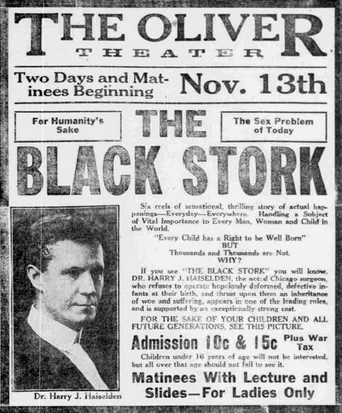
Heredity and eugenics are the whole point of the film. It argues that "defective" traits pass inevitably from parents to children, so that letting a malformed newborn die protects future generations, a view it supports with the mother's vision of her son fathering disabled children. The doctor is not a geneticist but a real surgeon who used the film to defend his practice of withholding treatment from disabled infants; he presented this as a scientific and humane choice. In the real Bollinger case, Chicago's health commissioner testified that the baby's condition was treatable, and a coroner's jury rejected Haiselden's claim that the child would have grown up mentally or morally defective. Haiselden was expelled from the Chicago Medical Society over his publicity, yet the film circulated in the United States for years, in the era of American eugenic sterilisation laws. It is a historical document of how eugenic ideas were sold to the public, not a portrayal of genetic science.
The story
The Black Stork, also released as Are You Fit To Marry?, is a silent eugenics propaganda film written by and starring the Chicago surgeon Harry J. Haiselden, who plays himself. It opens with a warning that social problems such as crime and poverty result from careless management of human breeding. A newborn baby is born with severe malformations, and the doctor refuses the surgery that could save its life, telling the mother that "God does not want this child to live." The medical profession is outraged, but the mother has a vision of her son's future: disabled, unhappy and violent, and the father of five disabled children of his own. Convinced, she lets the baby die, and the film ends with Jesus receiving the infant's soul as the doctor looks on. The story dramatises Haiselden's real refusal to operate on the newborn Allan Bollinger in 1915.