The genetics
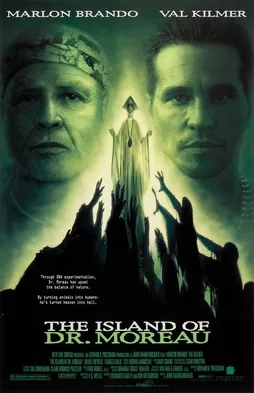
In Wells's novel, Moreau makes his beast-men by vivisection; this 1996 version recasts him as a genetic engineer who introduces human DNA into animals in search of a higher being incapable of harm. The hybrids are unstable: they need regular drugs to stop them from "retrogressing", and Moreau plans to use Douglas's DNA to stabilise his daughter Aissa permanently. The film keeps the novel's questions about cruelty, moral responsibility and human interference with nature. Moreau is an exiled, god-like scientist who believes his aims are benevolent but rules his creations through pain and fear, and whose work ends in rebellion and bloodshed. Genetics here is central but entirely speculative: animal-human hybrids of this kind, with human speech and intelligence, have no counterpart in real science, and the idea of creatures sliding back towards their animal origins owes more to nineteenth-century anxieties about evolution than to how genes work.
The story
United Nations negotiator Edward Douglas survives a plane crash in the Java Sea and is taken by Montgomery to an island ruled by Dr. Moreau, a scientist who fled the United States after a backlash against his experiments on animals. In the laboratory, Douglas sees a human-animal hybrid give birth and finds Moreau's daughter Aissa, who takes him to the village of the "Beast-Folk". Moreau, worshipped as a father by his creatures, controls them with drugs and with electrical implants that inflict pain. When the hyena-swine hybrid discovers his implant and removes it, the creatures rebel and kill Moreau. Montgomery destroys the serum that stops the hybrids from reverting to animals, and Aissa, also a hybrid, begins to regress before she is killed. As the island descends into violence, Douglas turns the new leader against his followers and escapes on a raft, seen off by the peaceful hybrids. The film is the third major adaptation of H. G. Wells's 1896 novel.