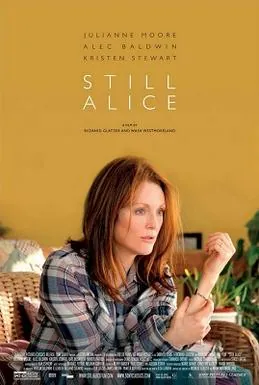
The genetics
Genetics is central to the family drama. Alice has the rare familial form of early-onset Alzheimer's disease, caused by a single mutation inherited in an autosomal dominant pattern, so each of her children has a 50% chance of having inherited it. The film portrays the dilemma of predictive genetic testing for an incurable disease: Anna learns she carries the mutation, Tom that he does not, and Lydia chooses not to know. Doctors are shown as competent and humane, and there is no villain: the story is about how a family lives with a genetic diagnosis. The film is medically accurate on this point. Familial Alzheimer's disease is caused by mutations in at least three genes, APP, PSEN1 and PSEN2, and it accounts for only a small fraction of all cases: most early-onset Alzheimer's, like the common late-onset form, is not caused by any known mutation. The film is based on Lisa Genova's novel, and Julianne Moore won the Academy Award for Best Actress for the role.
The story
Alice Howland, a renowned linguistics professor at Columbia University, begins to forget words and gets lost on a familiar campus shortly after her 50th birthday. She is diagnosed with early-onset familial Alzheimer's disease. Because the condition is inherited, her adult children face the choice of being tested: her elder daughter Anna tests positive, her son Tom tests negative, and her younger daughter Lydia, an aspiring actress, declines. As her memory declines, Alice uses her phone to quiz herself each morning and records a video instructing her future self to take an overdose of pills when she can no longer answer. She loses her job, gives a moving speech at an Alzheimer's conference and gradually fails to recognise her family. When she finds the video, she is interrupted before she can follow its instructions. Her husband John moves to a new job, and Lydia returns home to care for her.