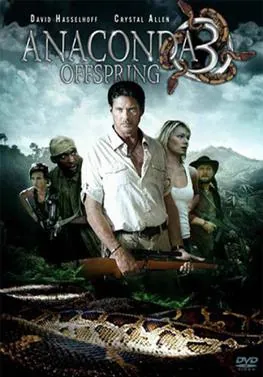
The genetics
Genetic research is the source of the threat, although the film is mainly a creature feature. The anacondas are kept for experiments at a corporate genetic research facility working on a serum derived from the Blood Orchid, and the danger is that the pregnant queen will give birth to more genetically "special" offspring. The scientists work for a wealthy industrialist who funds the research for profit and is willing to sacrifice everyone to obtain a live specimen; the lead researcher, Amanda, admits her responsibility only reluctantly and ends by destroying her own documentation, a gesture against the misuse of her work. The film thus repeats a familiar pattern of the genre: commercial genetic research, poor containment and an animal that turns on its creators. Its science is not developed beyond this premise. Real anacondas are among the largest snakes, but no genetic technique could produce animals of the size and abilities shown.
The story
A giant anaconda captured in the Amazon is held at a genetic research facility in Romania owned by the company Wexel Hall, where scientists led by Dr. Amanda Hayes are developing a serum from the Blood Orchid, a plant recovered in Borneo. When the project's backer, the industrialist J.D. Murdoch, provokes the snake, it breaks free, kills many of the staff and releases a second, "queen" anaconda. Murdoch sends the hunter Stephen Hammett and his team after the snakes. As the hunters are killed one by one, Amanda admits that the queen is pregnant and will soon give birth to genetically altered offspring. Hammett turns out to be working for Murdoch, who wants a live baby snake. Amanda wounds him and blows up the factory where the queen gives birth, killing Hammett, the queen and her young. However, one of Murdoch's men finds a surviving baby snake and delivers it to him, while Amanda burns her research.