The genetics
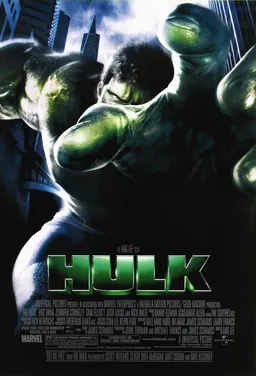
Ang Lee's film changes the Hulk's origin to make heredity central. Bruce's condition begins with his father's self-experimentation: David Banner, a researcher for the military, alters his own DNA in pursuit of human improvement, passes the change to his son, and the gamma accident decades later only activates what Bruce inherited. Much of the film is a family drama about what children inherit from their parents, biologically and emotionally, with Bruce's repressed childhood trauma acting as the trigger for each transformation. Scientists are shown at their worst through David, whose ambition turns to megalomania and who uses his son's DNA to create monstrous dogs, while military and corporate interests, represented by Ross and Talbot, want to exploit the Hulk for regenerating soldiers. The genetics is fictional, but the film touches on a real distinction: changes to a person's germline, unlike those to other body cells, can be passed to the next generation, which is why editing the genomes of human embryos is so tightly restricted today.
The story
In the 1960s, David Banner, a government genetics researcher trying to improve human DNA, experiments on himself after his superior, Thaddeus Ross, forbids tests on humans. His son Bruce inherits his altered DNA. When Ross shuts down his research, David sabotages a gamma reactor and accidentally kills his wife; he is sent to a mental hospital, and Bruce is adopted and represses the memory. As an adult, Bruce works on regenerative "nanomeds" at Berkeley with Ross's daughter Betty. Shielding a colleague in an accident, he absorbs a massive dose of gamma radiation that merges with his altered DNA, and from then on rage turns him into the Hulk, a giant green creature. David, now a lab janitor, uses Bruce's DNA to mutate dogs that attack Betty. The military, now led by General Ross, and the corporate opportunist Talbot try to capture the Hulk. David gains the power to absorb energy and matter and fights his son until a bomb destroys him; Bruce is presumed dead.