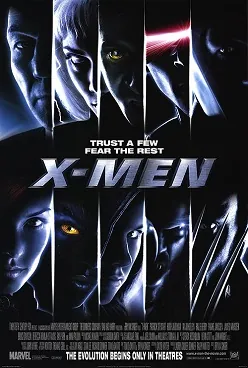
The genetics
Genetics is present as the premise rather than as science. Mutants are people born with mutations that give them extraordinary powers, usually emerging in adolescence; the plot is about how society treats them, from the registration law proposed by Senator Kelly to Magneto's plan to force mutation on world leaders with radiation. No geneticist appears: the leading characters are mutants themselves, and Magneto's machine is the only experiment in the story, one that kills its first human subject. The film works as an allegory of discrimination against minorities. It opens in Auschwitz, linking the registration of mutants with Nazi persecution, and director Bryan Singer described the mutants as outsiders whose difference appears at puberty, an allegory that actor Ian McKellen read as being about gay people. Real mutations do not produce abilities of this kind, and radiation causes random DNA damage rather than useful new traits.
The story
In a world where some people are born as mutants with superhuman powers, US Senator Robert Kelly campaigns for a Mutant Registration Act. The telepath Charles Xavier, who runs a school for young mutants, fears the response of his old friend Erik Lehnsherr, known as Magneto, a Holocaust survivor who can control magnetic fields. Rogue, a teenager whose touch absorbs other people's life force and powers, runs away from home and meets Logan, or Wolverine, a mutant with metal claws and accelerated healing. After the members of Magneto's Brotherhood attack them, both are taken to Xavier's school, home of the X-Men. Magneto has built a machine that generates radiation able to induce mutations in normal humans; tested on Senator Kelly, it eventually kills him. Magneto plans to use it on the world leaders gathered at a summit on Ellis Island, powering it through Rogue at the cost of her life, but the X-Men defeat the Brotherhood on the Statue of Liberty and destroy the machine, and Logan saves Rogue by transferring his healing power to her.