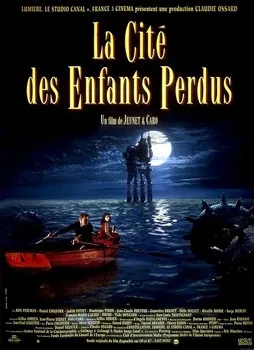
The genetics
Genetics is not explained in detail, but the story depends on artificial creation. The absent scientist has made a whole household of beings on the rig: a set of identical clones, the dwarf Martha, the disembodied brain Irvin and Krank himself. Each creation is flawed in some way, and Krank's inability to dream, which makes him age prematurely, drives his cruelty towards the city's children. The scientist is a lonely, Frankenstein-like figure who wanted to build a family of companions, and his creations betray and abandon him; he ends the film half mad, trying to destroy what he made. The film is a dark fairy tale rather than science fiction in any technical sense, and cloning is shown as a way to produce adult copies at will, which bears no relation to the real technique. Its interest lies in its portrait of a creator who cannot make his creatures whole, and in the moral damage that flows from them.
The story
On an abandoned oil rig off a port city lives Krank, a malevolent being created by a vanished scientist. Krank cannot dream and is ageing prematurely, so he steals the dreams of children kidnapped for him by the Cyclops, a cult of men with mechanical eyes. He shares the rig with the scientist's other creations: six identical, childlike clones, a dwarf named Martha and Irvin, a talking brain in a tank. When the Cyclops kidnap Denrée, the adopted little brother of the carnival strongman One, One sets out to find him with Miette, a sharp orphan girl from a gang of child thieves. A bottled message from Irvin reveals the truth to an amnesiac diver living under the harbour, who turns out to be the scientist himself, thrown off the rig by Krank and Martha. Miette defeats Krank inside a dream, the children are freed and the rig explodes.