The genetics
Genetics enters through classical heredity rather than genetic engineering. Claudandus, the survivor of cruel animal experiments, was taken in by a former laboratory assistant and learned Mendel's laws of inheritance. He uses them to run a eugenic breeding programme, selecting mates over generations to bring back the traits of an imagined ancestor of all domestic cats, a superior breed meant eventually to wipe out humanity. Cats who refuse to take part are murdered. The villain is thus both a victim of science and a self-taught geneticist who turns its methods into a racial project, with clear echoes of human eugenics; Mendel himself appears in Francis's nightmares. The scientists of the original laboratory are portrayed as cruel and, in Preterius's case, unhinged. The approach Claudandus uses is real in principle: domestic animal breeds are produced by selective breeding, and Mendel's experiments on pea plants established how traits are passed on. Recreating an ancestral species this way, however, is far beyond what breeding can achieve.
The story
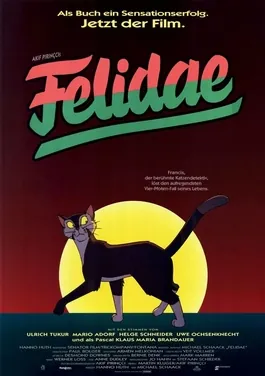
In the late 1980s, Francis, an intelligent house cat, moves with his owner into a run-down house and finds a cat killed by a bite to the neck. With the help of the one-eyed Bluebeard, he investigates a series of feline murders and discovers a sect of cats that worships a figure called Claudandus. A video recording reveals that the top floor of his house was once a laboratory where stray cats were used to test a tissue glue, until the only survivor, Claudandus, killed the deranged lead researcher, Dr. Preterius. Haunted by nightmares of the geneticist Gregor Mendel, Francis finally learns that the killer is Pascal, the elderly, computer-literate cat who is Claudandus himself. Pascal has spent years breeding a new race of cats and killing those who refused to cooperate. Francis deletes his records, and in the fight that follows Claudandus dies as the house burns. The film is an animated adaptation of Akif Pirinçci's 1989 novel.