The genetics
Life Story is a historical drama about the founding discovery of molecular genetics, the 1953 double-helix model of DNA, and its scientists are real people. It contrasts two styles of research: Watson and Crick's intuitive leaps and model building, and Franklin's careful experimental work, against a background of competition, personal friction and the marginalisation of a woman scientist. It shows how Watson and Crick won partly by reasoning from DNA's genetic function to predict its chemical structure. The film follows the record closely; Crick wrote that it had a few inaccuracies, such as making Watson too manic, but called it a success overall. Historically, Franklin and Raymond Gosling's X-ray image known as Photo 51 was shown to Watson by Wilkins without their knowledge and was key evidence for the helix. In 1962 Watson, Crick and Wilkins received the Nobel Prize; Franklin had died in 1958, and the prize is not awarded posthumously.
The story
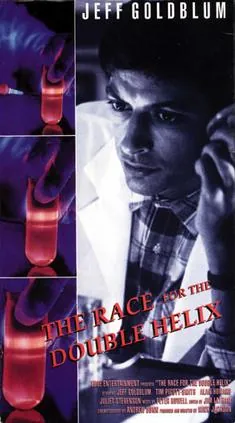
This BBC drama, made for the Horizon science series, follows the race to determine the structure of DNA in the early 1950s. In Cambridge, the young American James Watson and the British physicist Francis Crick try to guess the structure by building models, reasoning from what the molecule must do. At King's College London, Maurice Wilkins and Rosalind Franklin work with X-ray diffraction, but their partnership is soured by mutual mistrust, and Franklin insists on patient measurement before theorising. Both teams also fear being beaten by the American chemist Linus Pauling. The film portrays the rivalries, the institutional turf wars and the sexism that Franklin faces, and ends with Watson and Crick building the double-helix model. It was written by William Nicholson, based on Watson's memoir The Double Helix, and stars Jeff Goldblum, Tim Pigott-Smith, Juliet Stevenson and Alan Howard.